A conversational platform that turns evolving guidelines into governed, reusable decision logic—cutting policy-change turnaround by an estimated 60% and saving approximately $250K annually.
This case study presents selected work. Non-disclosure agreements prevent me from sharing the full set of project artifacts.
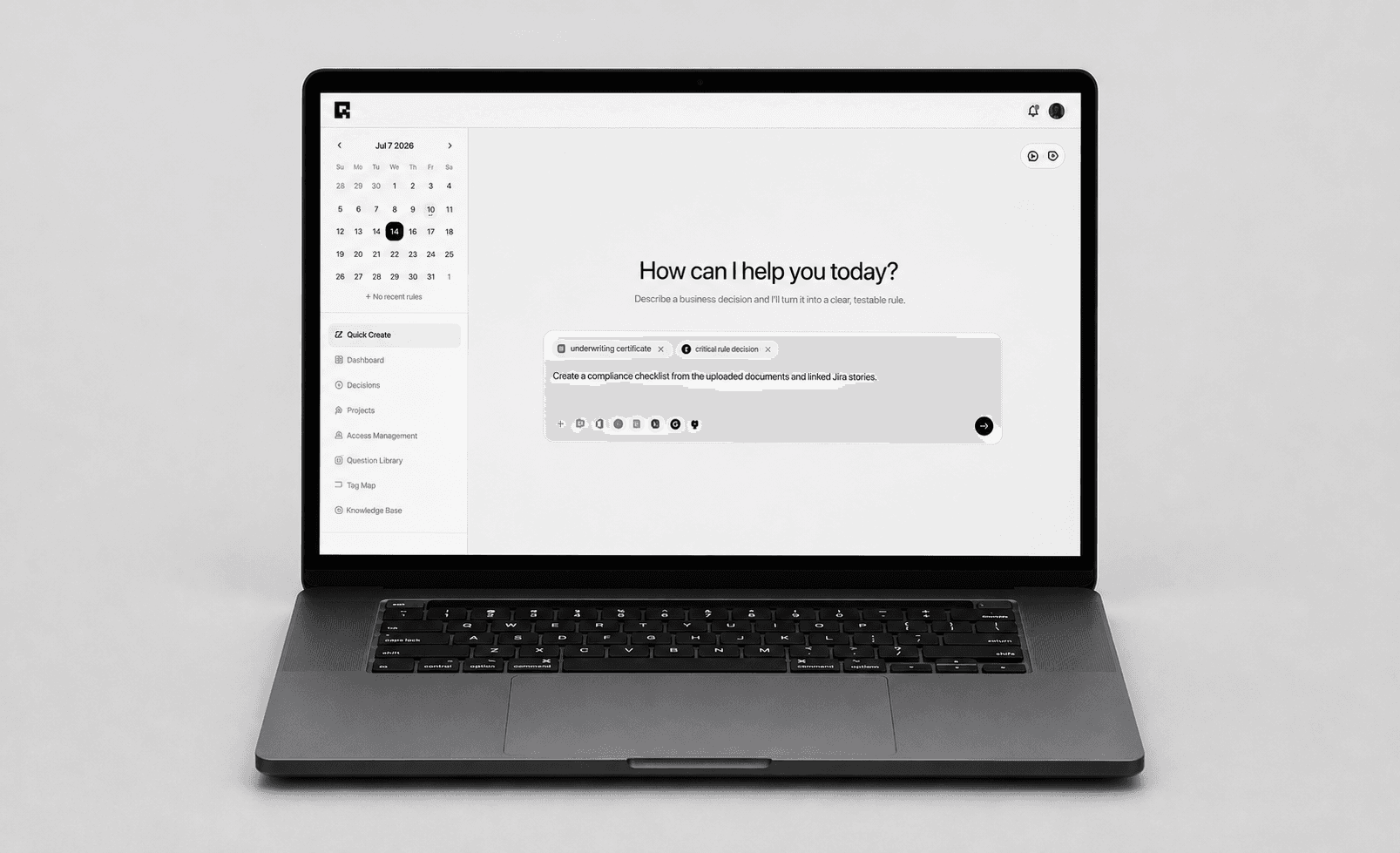
One workspace for governed rules
Quick Create, checklists, and the dashboard bring authoring, review, and monitoring into a single conversational shell.
Product Lead & UX ArchitectProduct strategy, research, conversational UX, governance, micro-frontend architecture, visual design, and the coded prototype.
02 Collaboration
Six disciplinesPolicy, operations, product, engineering, risk, and compliance from discovery through validation.
03 AI execution
Grounded copilotTurns natural-language intent into editable SOP steps, conditions, and exceptions—each traceable to Jira, Teams, GitHub, or SharePoint.
04 The impact
60% faster policy changeUp to two engineering days saved per update and approximately $250K annually, with no duplicate rule implementation.
The problem
Policy moved faster than code.
Rules were duplicated across codebases, every update entered CI/CD, and users moved between disconnected tools to complete one outcome.
01
Workflow frictionUser problem
Rigid tools could not capture real-world exceptions, forcing teams to search across systems and manually carry context through the workflow.
More searching. Less deciding.
02
Delivery costBusiness problem
Every policy change triggered repeated engineering work, cross-team coordination, and another application release.
More releases. Slower policy.
03
Industry economicsMarket pressure
Technical debt consumes an estimated 23% of developer time, and U.S. software debt has reached $1.52 trillion. Policy embedded in code adds to that burden.
Help teams update business rules quickly without waiting for application releases or disrupting the user journey?
My role / From insight to implementation
What I did.
I led product strategy, research, conversational UX, and architecture, and built agents to extend the work.
Start before the visible workflow.
Human leadership Led by me
Understand how SOP builders think
Interview policy, operations, risk, and compliance stakeholders.
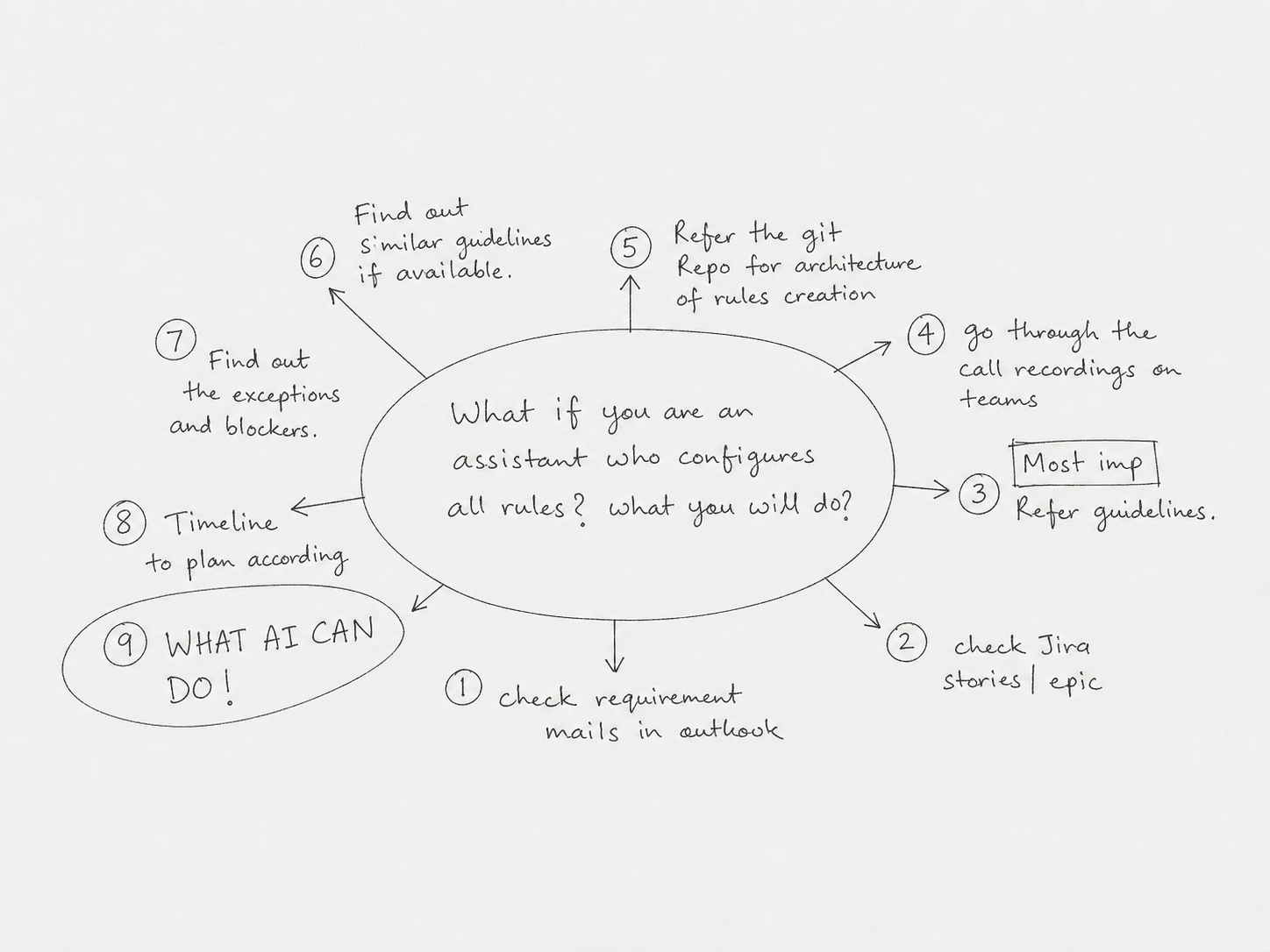
Trace how users recognise a need, search for context, and handle uncertainty.
Map where guidance lived: email, Jira, Teams, GitHub, SharePoint.
Agent support Built by me
Research synthesis agent
I built an agent to cluster interview notes and source inventories into themes that I reviewed and turned into the mental model.
Human direction. Agent assistance.
What this creates
User mental model & source map
Explore each phase to see what I led, what I built, and how the work came together.
Research / Understanding the work
Product research.
My discovery starts before the visible workflow. I trace how users recognise a need, find information, and navigate uncertainty—the mental model behind the documented process.
5+
Business experts, not rule-engine specialists—working from five or more disconnected sources per rule.
SOP builders think in outcomes, exceptions, and sequence, but their knowledge is scattered across emails, Jira, Teams recordings, GitHub, and SharePoint.
Traced how SOP builders search, interpret, and plan before any rule is written—revealing the searching and reconciling a conventional workflow map would have missed.
Start with a conversation, not an empty canvas.
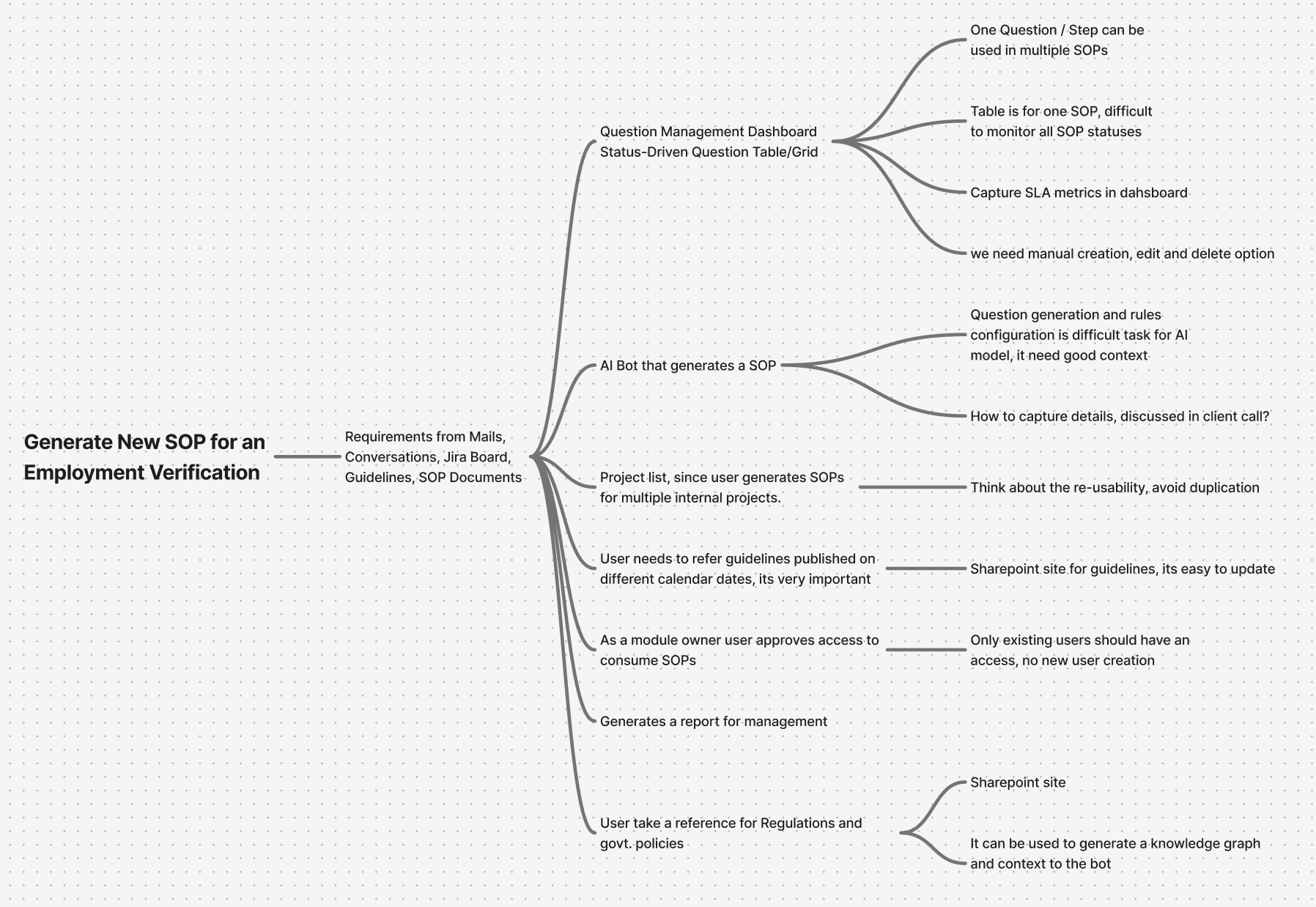
Ideation method / FigJam
Asynchronous ideation
Replaced a single workshop with a shared board stakeholders could build on across time zones, bringing requirements, questions, and constraints into one view.
Make brainstorming visible and reusable as product input.
Design implication: Rule Q should not begin with an empty rule canvas. It begins with a conversation, helps the user assemble trusted context, exposes uncertainty, and generates a reviewable first draft. The human owns intent and approval; the AI accelerates discovery, synthesis, and configuration.
Design / Bringing it together
Solution & architecture.
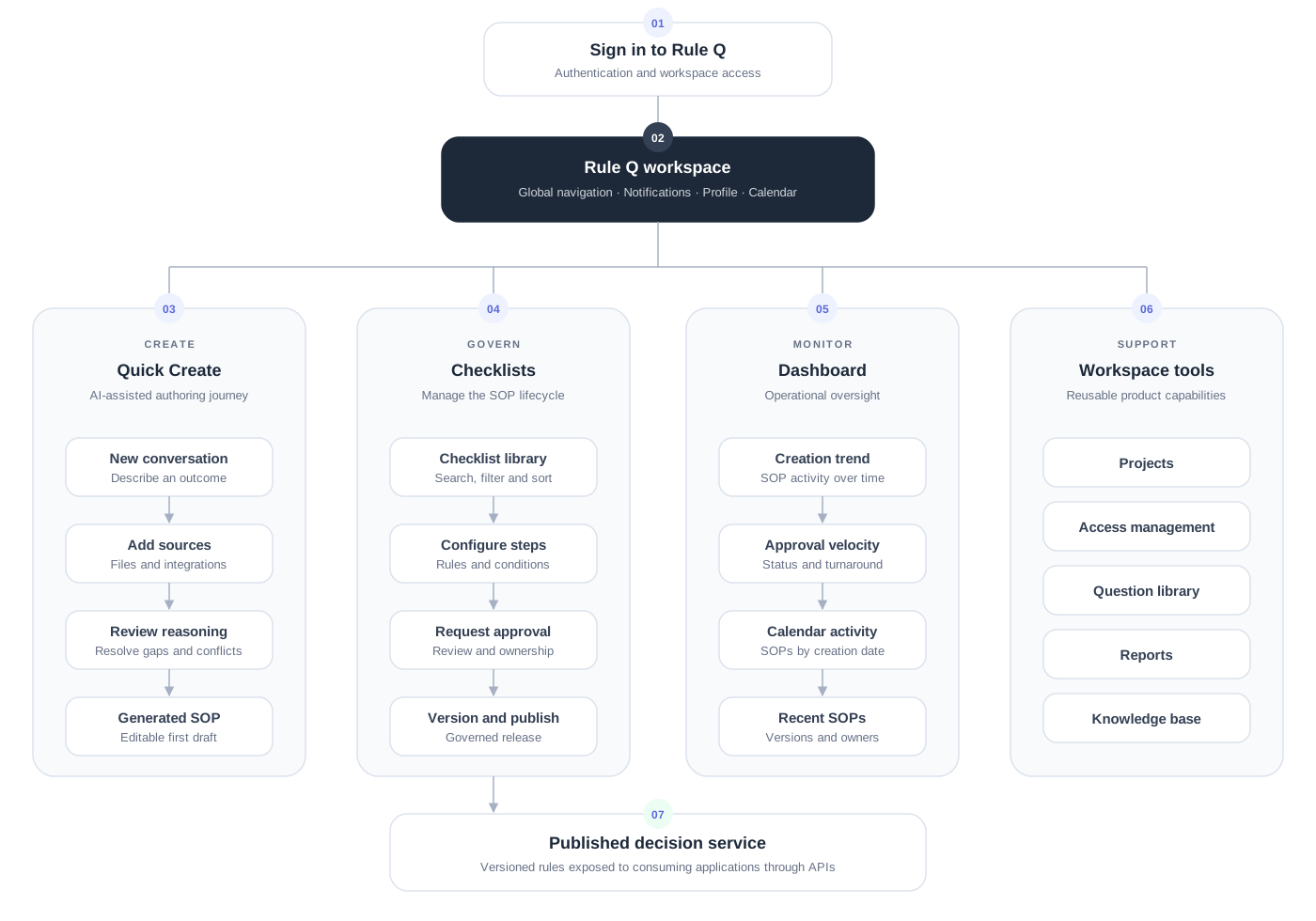
One workspace, distributed logic—creation stays prominent while governance runs in the background.
1. Gather2. Make sense3. Build & publish
Organising the workspace around the life of an SOP: sign-in leads to a shared workspace, then branches into Quick Create, Checklists, Dashboard, supporting tools, and the published decision service.
Technical / Frontend strategy
A platform boundary teams can build against.
LogicPolicy layer
A canonical rule model separates frequently changing business guidance from slower product release cycles.
DistributionAPI contracts
Stable, version-aware request and response schemas let consuming applications integrate without duplicating logic.
ExperienceComposable UI
Micro-frontends contribute focused capabilities to a shared shell while preserving independent team ownership and deployment.
TrustGovernance by design
Source references, test scenarios, approvals, versions, and audit history travel with each published decision.
From design to experience
Take a closer look.
Step inside the working prototype to explore the login, conversational rule builder, and governed workspace.